
Engineering guide · Injection molding
Types of Injection Molds: Runner, Cavity & Side-Action Selection
Our PartsMake engineering team wrote this guide for buyers who need to choose tooling—not collect mold encyclopedias. We focus on cold vs hot runner, cavity count, plate design, and side actions, then give a selection checklist and RFQ pack you can send with the drawing.
Starting point: one tool can be hot-runner, multi-cavity, two-plate, and side-action at once. Pick each axis for geometry, volume, and budget—not a single buzzword.
Quick Decision Matrix
Use this matrix when you brief our PartsMake engineering team. It is planning guidance—not a substitute for DFM on your resin and geometry.
| Decision axis | Lean this way when… | Watch-outs |
|---|---|---|
| Cold runner | Prototype / bridge tools, uncertain volume, simpler upkeep | Runner scrap, gate vestige, extra handling |
| Hot runner | Higher output, material savings justify manifold cost | Higher tooling cost, heater/maintenance skill needed |
| Single cavity | Validation, complex part, or low annual volume | Lower parts per cycle |
| Multi-cavity | Stable design, volume that pays for balanced fill | Cavity-to-cavity variation; higher steel & tryout cost |
| Side action / slides | Undercuts, side holes, threads that cannot draft out | Tool complexity, wear, longer cycle, higher maintenance |
What Is an Injection Mold?
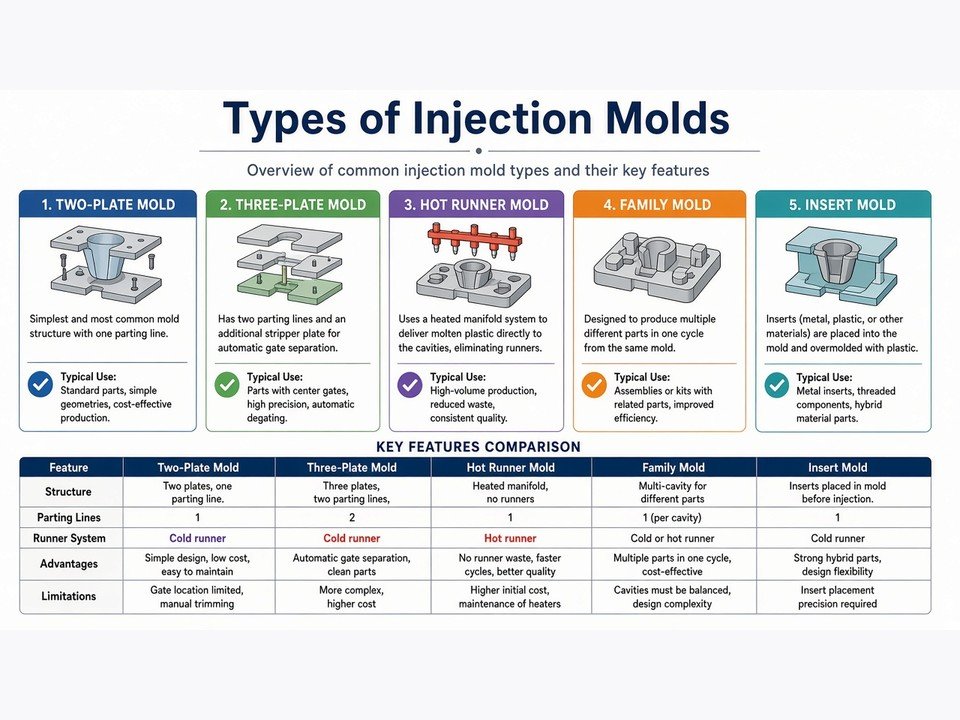
The mold is the precision tool—core, cavity, runners, cooling, and ejection—not the molding machine itself.
An injection mold is the tool that shapes molten plastic into a finished geometry each cycle. The press injects, cools, opens, and ejects; the mold defines walls, gates, cooling, and how undercuts release.
When volume is still uncertain, we often prototype the part in CNC milling or 3D printing first, then commit steel only after fit and function are proven. Bridge or soft tooling can sit between those steps when you need molded resin properties without full production steel.
Cold Runner vs Hot Runner
Runner choice sets scrap, gate options, and tooling complexity. Our PartsMake engineering team weighs resin behavior and annual volume before recommending a hot manifold.
| Consideration | Cold runner | Hot runner |
|---|---|---|
| Material path | Runner cools and ejects with the part | Heated manifold keeps melt near the gate |
| Scrap / handling | Runner scrap or regrind handling | Less runner scrap when the system is stable |
| Tooling & upkeep | Simpler build and service | Heaters, tips, and controls to maintain |
| Typical fit | Prototypes, low–mid volume, cost-sensitive tools | Higher output where material and cycle savings pay back |
Shop note
Volume alone does not decide. Gate cosmetics, shear-sensitive resins, and maintenance capability matter as much as parts-per-year.
A rough inflection we use in quoting conversations: if annual volume stays in the low thousands and the design may still change, cold runner + single cavity usually wins on risk. When volumes climb into tens of thousands with a frozen drawing, we model hot-runner payback against resin price and scrap. Exact break-even is quote-specific—tell us resin cost and expected shots so we can run the numbers with you.
Single, Multi-Cavity & Family Molds
Cavity count sets parts per cycle and how hard balanced fill becomes. We start single-cavity when design is still moving; we add cavities when annual volume and stable drawings justify the steel and tryout cost. Doubling cavities does not simply halve piece price—tooling, tryout, and cavity balance often grow faster than output on the first production tool.
Single-cavity
Best for validation, complex geometry, or low annual volume. Faster to tool and easier to tune one cavity before scaling.
Multi-cavity
Raises output when fill, cooling, and dims stay consistent cavity-to-cavity. Budget for more steel, runner balance, and longer tryout.
Family mold
Forms related parts in one shot when volumes and flow needs align. Avoid when components need very different fill or quality rules.
Mold Plates & Side Actions
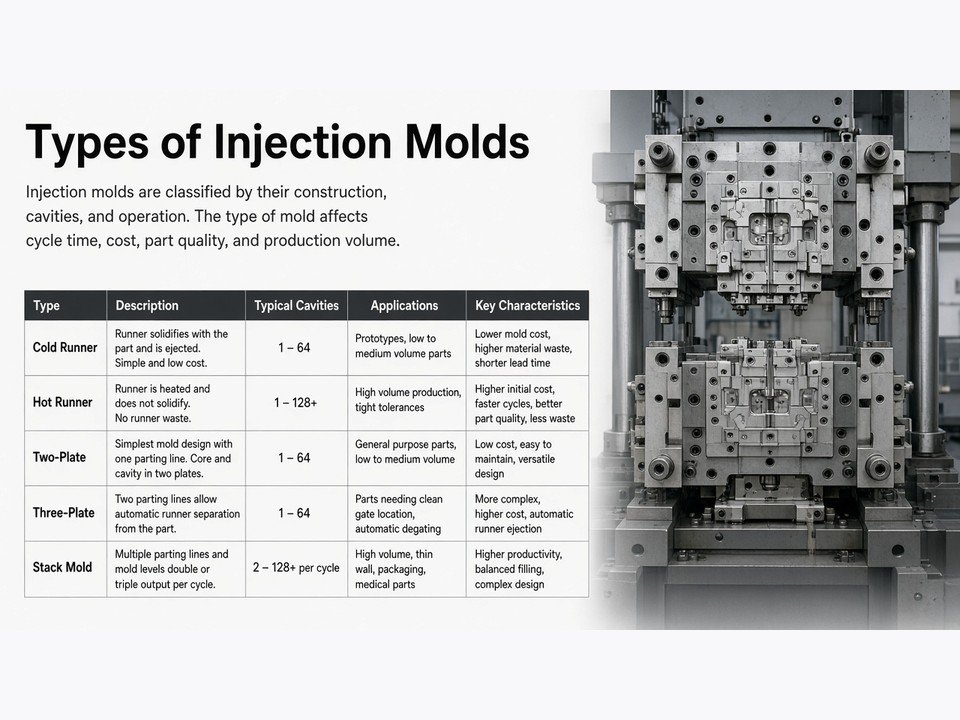
Plate count and side actions follow geometry—undercuts and gate layout drive complexity more than marketing labels.
Two-plate tools open on one main parting line—common, direct, and often enough when gates can sit on that plane. Three-plate tools add a stripper/runner plate so the runner can separate on a different plane and support different gating.
Straight-pull parts release with draft along the open direction. Side actions (slides, lifters, unscrewing) release undercuts, side holes, or threads that cannot draft out. Each mechanism adds cost, wear surfaces, and maintenance—so we challenge undercuts that can be redesigned with draft or a secondary op.
DFM tip from our team
Before locking slides, ask whether a redesign, a CNC secondary feature, or a different gate plane removes the undercut. Tooling complexity compounds cavity count and hot-runner cost quickly.
How We Choose the Right Tooling
Our PartsMake engineering team starts from the part and production plan—not a preferred mold label. Bridge tools and production steel answer different volume and life targets.
As a planning cue (not a formal SPI quote): soft/bridge tools suit short validation runs; harder production steels suit higher shot life and abrasive or filled resins. Tell us expected annual volume and resin fill so we can align steel class, cavity count, and runner choice instead of over-building the first tool.
Part geometry & release
Map draft, undercuts, threads, wall thickness, and cosmetic faces. Decide straight-pull vs slides before cavity count.
Volume & tooling budget
Estimate annual pieces and expected mold life (bridge vs production steel). Hot runner and multi-cavity only pay when volume is real.
Resin, cycle & quality
Name the resin early. Shrinkage, cooling, gate vestige, and weld lines drive plate and runner choices as much as volume.
Mold life & maintenance
Match steel class and hot-runner complexity to expected shots and your ability to service tips, slides, and cooling.
For process and DFM context beyond this tooling brief, see our injection molding DFM notes.
Tooling RFQ Checklist
Send this pack with STEP + 2D drawings and we can recommend runner, cavity, and side-action strategy before steel is cut:
- Resin & additives: grade, color, glass fill, FDA/UL if any; alternate resins allowed?
- Volume plan: prototype / bridge / annual production; expected mold life in shots.
- Cavity intent: single vs multi; family parts yes/no; critical dims that must match cavity-to-cavity.
- Gate & cosmetics: allowed gate faces, texture, ejector witness, parting-line preference.
- Undercuts / threads: must stay, or can redesign / secondary machine?
- Tolerances & tryout: critical GD&T, first-article needs, T0/T1 sample plan.
FAQ
When should we choose cold vs hot runner?
Choose cold runner for bridge tools, low volume, or when you want simpler maintenance. Choose hot runner when annual volume and material savings clearly pay for the manifold—and your resin and gate cosmetics fit a hot system.
How many cavities should the first tool have?
Start with one cavity if the design may still change. Add cavities when drawings are frozen and volume justifies balanced multi-cavity steel and tryout time.
Do undercuts always need side actions?
No. Draft redesign, split lines, or a secondary CNC feature can remove many undercuts. We recommend side actions only when the feature must stay and cannot release on open.
Should we CNC or 3D-print before cutting steel?
Often yes for fit/function. Molded resin behavior still needs a molded sample eventually—bridge tooling or a single-cavity cold-runner tool is the usual next step after CNC or additive validation.
Is there one official list of “types of injection molds”?
No. Buyer-facing lists mix runner, cavity, plate, and release features. Treat them as independent axes—the same tool can be hot-runner, multi-cavity, two-plate, and side-action together. That is why we select each axis against your geometry and volume instead of picking a single catalog label.
Discuss your project
Review your part with our PartsMake engineering team before tooling
Share geometry, resin, volume, gate/cosmetic limits, and undercut constraints. We recommend cold vs hot runner, cavity count, and side-action needs—and whether CNC or bridge tooling should come first.