
Engineering guide
CNC Precision Machining: Process, Types, Materials & Industry Applications
Learn how CNC precision machining turns digital designs into accurate, repeatable metal and plastic parts—from first CAD review through inspection, finishing, and production delivery.
Precision begins before cutting. In our experience at PartsMake, the best results come from connecting design intent, process planning, material behavior, and inspection requirements from the start.
What is CNC Precision Machining?
CNC precision machining is the controlled removal of material from a workpiece using computer numerical control equipment. A digital design is converted into programmed tool movements so that cutters, drills, inserts, or other tools produce a defined geometry.
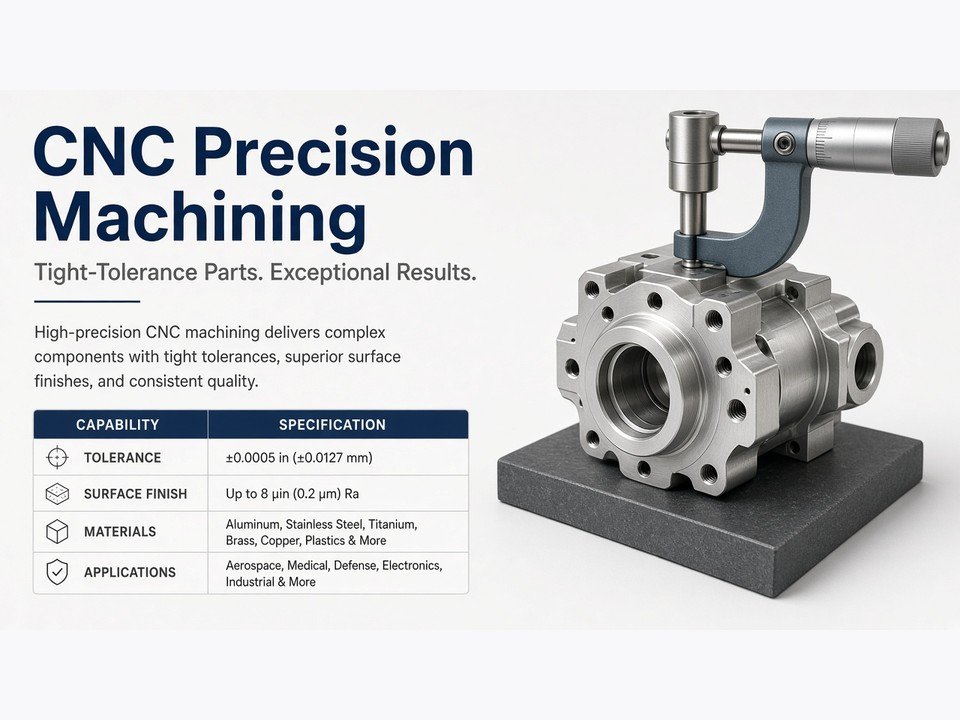
The word precision describes more than a machine’s nominal capability. It includes tight dimensional tolerances, controlled surface requirements, stable setups, accurate tooling, and repeatability from one part to the next. Standard CNC machining can be suitable for less demanding components, while precision work requires closer attention to critical dimensions, datum references, thermal effects, fixturing, and verification.
Accuracy
The finished feature must be located and sized in relation to the drawing, model, and datum structure.
Repeatability
The process must reproduce the same result across multiple parts, batches, and production stages.
At PartsMake, we review the part before production begins. That review considers the CAD file, drawing, material, quantities, tolerances, critical dimensions, surface requirements, and intended application.
Step-by-Step Guide to the CNC Precision Machining Process
A reliable CNC precision machining project is a connected workflow rather than a single machine operation. Each stage affects the next one, so we use a structured handoff from engineering review through final inspection.
-
1
Define the part requirements
Confirm the model, drawing, material, quantity, tolerances, finish, inspection needs, and delivery expectations.
-
2
Plan the process
Select the machining method, workholding strategy, cutting tools, setups, and inspection sequence.
-
3
Machine and control the part
Run the programmed operations while controlling workholding, tool condition, cutting parameters, and in-process checks.
-
4
Finish, inspect, and deliver
Remove burrs, apply required secondary processing, verify dimensions, and prepare parts for shipment or assembly.
Design and CAD Modeling
The process starts with a 3D CAD model and, when required, a technical drawing. The model defines the nominal shape; the drawing communicates tolerances, datums, surface requirements, threads, edge conditions, and other manufacturing details.
We look for features that may be difficult to hold or inspect, such as deep narrow pockets, thin walls, small internal radii, intersecting bores, or unclear datum relationships. Resolving these issues early can reduce rework and make the part easier to manufacture without changing its functional intent.
Design note
A tolerance should communicate a functional need. Applying very tight tolerances to every feature can increase machining time and inspection effort without improving assembly or performance.
CAM Programming and Toolpath Generation
CAM software converts the CAD geometry into toolpaths and machine instructions. The programmer selects cutting strategies, tools, speeds, feeds, stepovers, depths of cut, entry and exit movements, and the order of operations.
For precision work, the toolpath must balance cycle time with tool deflection, heat generation, chip evacuation, surface quality, and dimensional stability. Simulation helps identify collisions, over-travel, holder interference, and areas where the tool cannot reach the required geometry.
Machine Setup and Tooling
Setup includes selecting and securing the raw material, establishing work offsets, loading tools, confirming tool lengths and diameters, and checking that the fixture provides adequate support. The objective is to hold the workpiece securely without distorting it or blocking the toolpath.
Workholding: establish stable references and prevent movement during cutting.
Tool selection: match cutter geometry and tool material to the workpiece and feature.
Calibration: verify offsets, tool condition, probing references, and setup alignment before production cutting.
Machining the Part
The machine removes material through operations such as facing, roughing, pocketing, contouring, drilling, boring, threading, turning, and finishing passes. Roughing removes most of the excess material efficiently; semi-finishing and finishing operations establish the final size and surface condition.
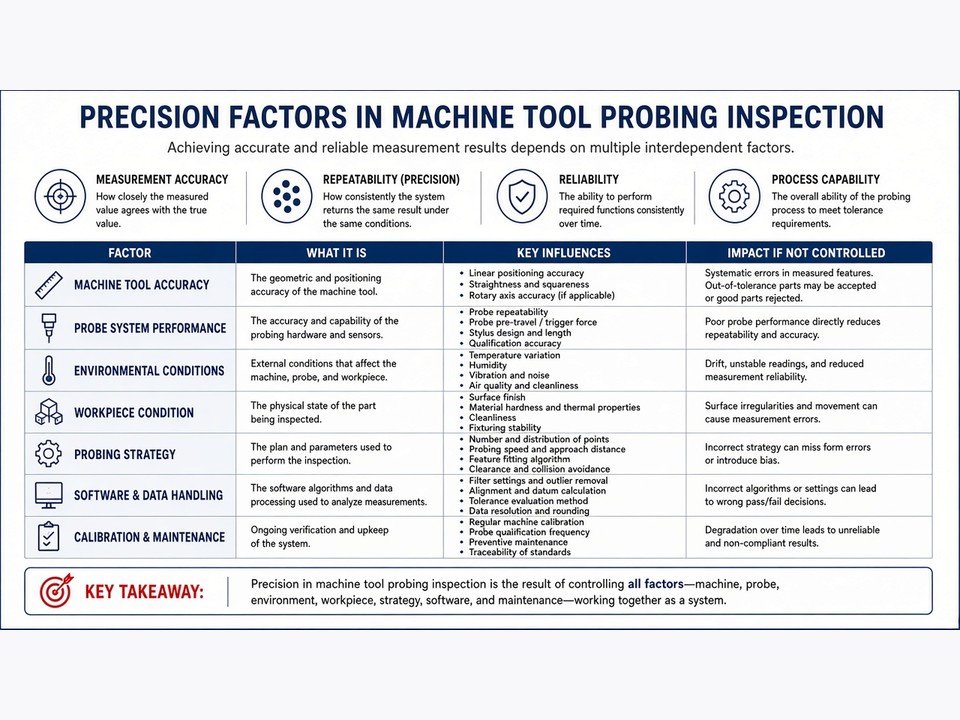
During production, operators monitor tool wear, chips, coolant, vibration, workpiece temperature, and the behavior of critical features. A planned sequence may also reduce the number of setups, which helps limit accumulated locating error.
Post-Processing and Quality Inspection
After machining, parts may require deburring, cleaning, surface finishing, heat treatment, coating, grinding, or other secondary processing. The correct treatment depends on the material, application, appearance, wear requirements, and drawing.
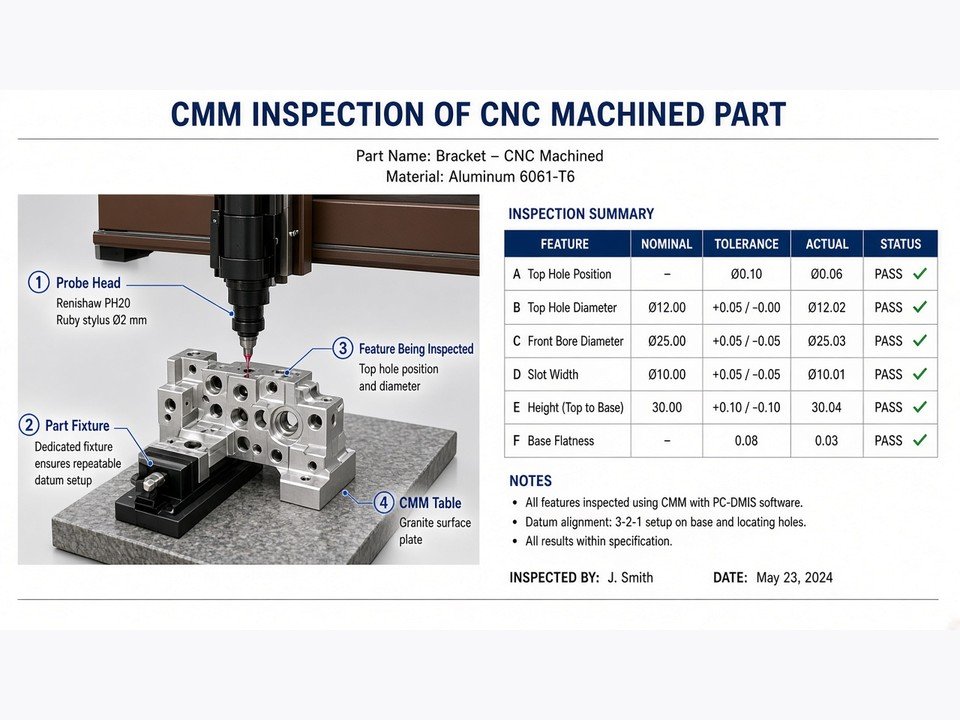
Inspection may include calipers, micrometers, gauges, height measurement, optical measurement, or coordinate measuring machine verification. A CMM can compare measured points or surfaces with the CAD model and drawing requirements. At PartsMake, inspection is planned around the project’s critical dimensions and quality requirements rather than treated as an afterthought.
Types of CNC Precision Machines
Different machine categories suit different geometries, materials, quantities, and tolerance requirements. Choosing the process is usually more important than choosing a machine by axis count alone.
CNC Milling Machines
CNC mills rotate a cutting tool against a secured workpiece. Three-axis milling is suitable for many plates, brackets, housings, pockets, and prismatic components. Four-axis equipment adds rotational positioning or motion that can expose additional faces with fewer manual setups.
Five-axis machining adds two rotational axes to three linear axes. Depending on the machine and strategy, it can reach multiple faces, follow complex surfaces, shorten tools, and reduce repositioning. PartsMake supports 3-axis, 4-axis, and 5-axis CNC milling, including simultaneous and positional five-axis work.
CNC Turning and Lathes
CNC turning rotates the workpiece while a tool removes material from its outside diameter, inside diameter, face, groove, or thread. It is well suited to shafts, pins, bushings, sleeves, collars, and other cylindrical components.
Multi-axis turning and mill-turn machining combine turning with driven milling tools. This can produce complex cylindrical parts with cross-holes, flats, slots, or milled features in one coordinated process. Swiss machining is also useful for small precision components, with PartsMake supporting precision machining for parts up to Ø32 mm through this capability.
CNC Grinding, EDM, and Laser/Plasma Systems
Grinding removes small amounts of material with an abrasive wheel and is used for precision mating surfaces, wear surfaces, and dimensional refinement. It can include surface, cylindrical, and centerless grinding.
Electrical discharge machining, or EDM, uses controlled electrical discharges to remove conductive material. Wire EDM produces precise profiles, while sinker EDM creates cavities and details with an electrode. These methods are valuable for hardened materials, narrow features, and complex profiles that are difficult to cut conventionally.
Laser and plasma systems are generally selected for efficient sheet or plate cutting rather than the same feature work as milling, turning, or EDM. The right choice depends on thickness, edge requirements, geometry, and downstream operations.
Materials Suitable for CNC Precision Machining
Material selection affects cutting forces, tool wear, heat management, achievable finish, part weight, corrosion resistance, and cost. We recommend selecting material from the part’s functional requirements first, then confirming that the planned process can support the design.
Metals
| Material group | Machining considerations | Typical uses |
|---|---|---|
| Aluminum | Generally machinable and lightweight; alloy choice affects strength and finish. | Housings, brackets, fixtures, structural parts, and prototypes. |
| Stainless steel | Can generate heat and work-harden, making tooling and cutting control important. | Medical, food-related, industrial, and corrosion-sensitive components. |
| Titanium | High strength-to-weight performance but requires careful heat and tool-wear management. | Aerospace, defense, medical, and high-performance assemblies. |
| Engineering alloys | Machinability varies with hardness, thermal behavior, and alloy composition. | Wear parts, shafts, precision mechanisms, and specialized equipment. |
Plastics and Composites
Engineering plastics can provide low weight, electrical insulation, chemical resistance, low friction, or dimensional performance. However, plastics may expand, deform under clamping, or soften from cutting heat, so the setup and finishing strategy must be adapted.
PEEK is selected for demanding performance requirements, Delrin is valued for machinability and low-friction components, and carbon-fiber composites can provide stiffness and low weight. Composite machining also requires attention to fiber direction, edge quality, dust control, and delamination risk.
Key Applications and Industries
CNC precision machining is used wherever parts must fit, move, seal, locate, transfer heat, or withstand repeated loads. The same process principles apply across industries, but the critical characteristics differ by application.
Aerospace and Defense
Parts may require lightweight geometry, strong materials, controlled interfaces, and consistent documentation. Machined housings, brackets, structural components, and specialized fittings are common examples.
Automotive and Transportation
Precision machining supports prototypes, fixtures, shafts, brackets, enclosures, and functional production parts for conventional, electric, and new-energy transportation systems.
Medical Devices and Equipment
Medical and laboratory equipment can depend on cleanable surfaces, biocompatible or corrosion-resistant materials, accurate interfaces, and repeatable geometry for assembly and operation.
Other technical systems
We also support robotics and automation, AI hardware and thermal management, semiconductor equipment, electronics, industrial equipment, EV and new-energy projects, and drones.
Advantages of High-Precision CNC Machining
The value of precision machining is not limited to a smaller tolerance on a drawing. A controlled process can improve assembly, reduce variation, support complex designs, and make production more predictable.
Superior Accuracy and Repeatability
CNC equipment follows programmed coordinates consistently, while process planning and inspection provide control around those coordinates. Accuracy depends on the complete system: machine condition, setup, tool calibration, material stability, temperature, programming, and measurement.
Complex Geometries and Intricate Features
Multi-axis machining can reach multiple surfaces and follow compound curves with fewer setups. This is useful for contoured housings, impellers, medical components, aerospace structures, and parts with multiple intersecting features.
Efficiency, Surface Finish, and Scalability
Once a process is proven, the same digital program and inspection logic can support repeat production. Proper tooling and finishing passes can also improve surface quality, while combining machining with grinding, EDM, finishing, molding, sheet metal, or additive processes can reduce coordination overhead.
Practical takeaway
The most efficient process is not always the one with the shortest machine cycle. A process that avoids extra setups, protects critical surfaces, and verifies the right dimensions may deliver better total project performance.
CNC Machining Costs and Career Outlook
Pricing and career earnings both depend on context. A useful estimate requires more than a machine label or hourly rate, while a machinist’s income depends on skills, location, responsibilities, experience, and the type of work performed.
What Does CNC Precision Machining Cost Per Hour?
There is no universal hourly price for CNC precision machining. A project quotation may account for machine time, setup, programming, tooling, raw material, inspection, finishing, packaging, quantity, and shipping. Five-axis, mill-turn, Swiss, grinding, and EDM work can involve different equipment and preparation requirements.
To receive a useful quote, provide the CAD model, drawing, material, quantity, tolerances, surface requirements, and intended application. We review those details before recommending a process, so the estimate reflects the actual manufacturing route rather than an isolated hourly assumption.
Can a CNC Machinist Earn $100k a Year?
Yes, some CNC machinists can earn $100,000 or more annually, but it is not a standard outcome for every role. Earnings can be influenced by programming ability, multi-axis experience, setup and troubleshooting skills, leadership responsibilities, overtime, industry, geography, and the complexity of the parts being produced.
Current Trends in Precision CNC Machining
Precision manufacturing is evolving around fewer setups, better process visibility, greater automation, and stronger links between design data and production data.
Multi-Axis and Multi-Function Centers
Five-axis and mill-turn centers can combine operations that would otherwise require several setups or machines. This can improve access to complex features and reduce opportunities for locating error, provided the process is programmed and verified correctly.
AI, Robotics, and IIoT Integration
Robotics can support loading, unloading, and repetitive material handling. Industrial Internet of Things systems can connect machines, tooling, inspection, and production data to improve visibility. AI-assisted systems may help identify patterns in tool wear, cycle behavior, or quality data.
These technologies support skilled engineering and machining work; they do not remove the need to understand tolerances, materials, fixturing, cutting behavior, and the functional purpose of the part.
How to Choose the Right CNC Precision Machining Partner
A good supplier should be able to explain how the part will be made, how critical features will be controlled, and how the project can move from prototype to repeat production. We recommend evaluating the following points:
Engineering review
The supplier should review drawings, tolerances, material, critical dimensions, surface requirements, and application before production.
Process coverage
Look for suitable milling, turning, five-axis, mill-turn, Swiss, grinding, EDM, finishing, and inspection options when the project needs more than one process.
Quality planning
Ask which dimensions are inspected, how inspection results are recorded, and how critical requirements are verified.
Lifecycle support
Choose a partner that can support prototypes, engineering samples, pilot production, low-volume production, and repeat manufacturing.
Clear communication
Technical questions should be handled by people who understand manufacturing, materials, tolerances, finishing, and inspection.
PartsMake combines CNC machining, 5-axis machining, CNC turning, mill-turn machining, Swiss machining, injection molding, sheet metal fabrication, 3D printing, precision grinding, EDM, surface finishing, and inspection through one engineering and project management team.
Frequently Asked Questions
What is CNC precision machining?
It is the use of computer-controlled machining equipment to produce parts with tight dimensional control, repeatability, defined surface requirements, and verified critical features.
What is the difference between CNC machining and precision machining?
CNC machining describes the computer-controlled manufacturing method. Precision machining describes the level of dimensional control, repeatability, process discipline, and inspection required for the part. CNC equipment can perform both general and precision work depending on the process and requirements.
Can a CNC machinist make 100k a year?
Some CNC machinists can earn $100,000 or more, especially with advanced programming, multi-axis, setup, troubleshooting, leadership, or specialized industry experience. Earnings vary by role, location, overtime, and employer.
How much does CNC machining cost per hour?
There is no single standard rate. The total quotation depends on machine type, setup, programming, tooling, material, cycle time, inspection, finishing, quantity, packaging, and shipping. A CAD file and drawing allow a supplier to provide a more useful project-specific estimate.
Start a manufacturing review
Ready to discuss your CNC precision machining project?
Send PartsMake your CAD files, drawings, material requirements, quantities, tolerances, and finishing needs. We will review the part, identify manufacturing risks, and recommend a practical route from prototype to production.