
Materials engineering guide
316 vs 316L Stainless Steel: Differences, Properties & Best Uses
Our PartsMake engineering team compares 316 and 316L stainless steel across chemistry, strength, corrosion resistance, weldability, CNC machining behavior, cost, and applications—so you can spec the right grade and send a cleaner RFQ.
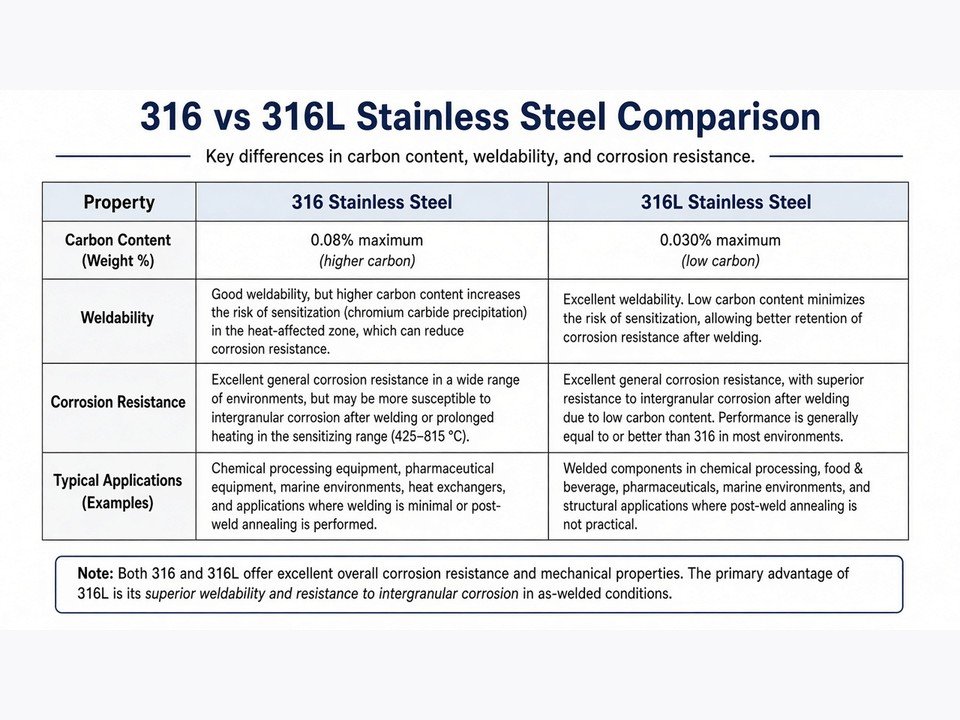
The practical difference we see on drawings is carbon content: 316L contains no more than 0.03% carbon, while standard 316 permits up to 0.08%. That small chemistry change is why our PartsMake engineering team usually steers welded, corrosion-critical assemblies toward 316L.
What Is 316 Stainless Steel?
316 stainless steel is an austenitic stainless grade containing chromium, nickel, and molybdenum. For broader stainless families we machine and finish, see our stainless steel overview. The molybdenum addition is the feature that separates 316 from 304 in many demanding environments: it improves resistance to chlorides, pitting, and crevice corrosion.
In the annealed condition, 316 is non-magnetic or only slightly magnetic, cannot be hardened by conventional heat treatment, and offers a useful balance of corrosion resistance, toughness, formability, and strength. It is commonly selected when a component will encounter salt, process chemicals, or elevated temperatures.
Engineering note
“316” describes a material grade, not a guaranteed surface condition or finished-part performance. Surface finish, contamination control, geometry, heat exposure, and the actual service chemistry still matter.
What Is 316L Stainless Steel?
316L is the low-carbon version of 316. The “L” stands for “low carbon,” with a maximum carbon content of 0.03% in common specifications. The alloy retains the chromium, nickel, and molybdenum system that gives 316 its corrosion resistance.
The lower carbon content reduces the likelihood of chromium carbide precipitation at grain boundaries during welding or other prolonged heat exposure. As a result, 316L is less prone to sensitization and the associated intergranular corrosion in the heat-affected zone.
316L is not automatically “more corrosion resistant” in every situation. In an unwelded part with the same finish and processing, the two grades often perform similarly because their principal corrosion-resisting alloying elements are nearly the same.
Chemical Composition Comparison
The table below shows typical composition limits used for wrought 316 and 316L stainless steel. Exact limits can vary by product form and governing specification, so we verify the required material standard when reviewing a drawing or purchase specification.
| Element | 316, typical limit or range | 316L, typical limit or range | Why it matters |
|---|---|---|---|
| Carbon | ≤ 0.08% | ≤ 0.03% | Controls weld sensitization risk |
| Chromium | 16–18% | 16–18% | Supports passive film formation |
| Nickel | 10–14% | 10–14%* | Stabilizes the austenitic structure |
| Molybdenum | 2–3% | 2–3% | Improves chloride corrosion resistance |
| Manganese | ≤ 2.00% | ≤ 2.00% | Processing and deoxidation element |
| Silicon | ≤ 1.00% | ≤ 1.00% | Supports steelmaking and oxidation control |
| Iron | Balance | Balance | Base metal |
*Composition ranges and limits depend on the applicable standard. Confirm the required certificate and product form before release.
Mechanical Properties and Strength
Both grades are ductile, tough austenitic stainless steels. Their mechanical properties depend on product form, thickness, cold work, and the governing specification. In common annealed wrought requirements, standard 316 may have slightly higher minimum strength than 316L.
Typical annealed minimums
Common reference values are approximately 515 MPa tensile strength and 205 MPa yield strength for 316, compared with approximately 485 MPa tensile strength and 170 MPa yield strength for 316L. The specification for the supplied material controls.
Hardness and temperature
Hardness limits are generally similar, and neither grade can be hardened by ordinary heat treatment. At elevated temperature, 316 can retain a small strength advantage, but design temperature, load duration, oxidation, and the complete material specification must be evaluated.
Design implication
For a highly loaded machined bracket or shaft, the small strength difference may matter. For a thin welded enclosure or fluid-contact manifold, weld integrity and corrosion behavior may matter more than the nominal strength advantage.
Corrosion Resistance and Weldability
The molybdenum in both grades improves resistance to chloride-induced pitting and crevice corrosion compared with 304 stainless steel. This makes either grade a strong candidate for many marine, chemical-processing, and washdown environments, although neither is immune to concentrated chlorides or poor design details that trap contaminants.
The most important difference appears after welding. With standard 316, carbon can combine with chromium in the heat-affected zone and form chromium carbides if the thermal cycle and cooling conditions allow it. The nearby metal can then become depleted in chromium, increasing the risk of intergranular corrosion. 316L substantially reduces this risk because its carbon content is limited to 0.03%.
Pitting and crevice corrosion
Both grades benefit from molybdenum, but actual performance depends on chloride concentration, temperature, deposits, surface condition, and crevice geometry.
Intergranular attack
316L is usually preferred for welded assemblies because its low carbon content limits chromium carbide precipitation during welding.
Fabrication quality
Correct joint design, heat input, shielding, cleaning, and post-weld surface treatment remain essential regardless of grade.
For welded parts, we review joint locations, material thickness, accessible surfaces, required finish, and inspection requirements before production begins.
Cost Difference Between 316 and 316L Stainless Steel
316L often carries a modest material premium over 316 because of tighter carbon control and availability by product form, thickness, and region. On our quotes the gap is usually small compared with machining, welding, finishing, and inspection.
Raw material is only one part of the finished cost. Machining time, welding, surface finishing, inspection, material certification, order quantity, logistics, and schedule can have a larger effect on the final part price. A material that costs slightly more can still provide better long-term value if it prevents weld-related corrosion, rework, or premature replacement.
When comparing quotations
- Compare the same specification: Grade alone does not define thickness, product form, finish, or certification requirements.
- Include manufacturing operations: A welded, passivated, inspected part should not be compared with a raw machined blank.
- Consider total risk: The lowest initial material price may not be the lowest lifecycle cost.
Are 316 and 316L the Same?
They are closely related, but they are not identical grades. Both use the same basic chromium-nickel-molybdenum system, while 316L has a lower permitted carbon content. That difference affects welding behavior and can affect the specified mechanical minimums.
In many general applications, 316L can substitute for 316 when the design does not require the higher strength minimum of standard 316 and the purchaser accepts the change. The reverse substitution is more restricted: using 316 in a welded corrosion-critical assembly may introduce unnecessary sensitization risk.
Do not substitute by name alone
Check the drawing, applicable material standard, weld procedure, pressure or structural requirements, customer approval, and any regulatory or traceability requirements before changing grades.
Best Applications for 316 Stainless Steel
Standard 316 is a practical choice when the component is primarily machined, formed, or fastened, and the design benefits from its commonly specified strength levels. It is especially relevant when welding is limited or when the material specification explicitly calls for 316.
Marine hardware and equipment
Use 316 for suitable marine components exposed to salt-laden environments, while accounting for stagnant water, crevices, deposits, and the specific chloride conditions.
Chemical-processing components
Pumps, brackets, fittings, housings, and fixtures may benefit from molybdenum-assisted corrosion resistance. The process chemical and temperature must still be checked for compatibility.
Higher-load or higher-temperature parts
Where the design is driven by strength and welding is not the controlling operation, 316 may offer a useful specification advantage over 316L.
Best Applications for 316L Stainless Steel
316L is often the more practical selection for welded assemblies, hygienic equipment, and components where corrosion at or near a weld would be difficult to inspect or repair.
Food and beverage equipment
Welded frames, fluid-contact components, fittings, and washdown equipment can benefit from the low-carbon grade when cleanability and weld-zone corrosion resistance are priorities.
Pharmaceutical and medical equipment
316L is widely considered for welded process equipment and medical components where corrosion control, surface requirements, and material traceability are important.
Water-treatment systems
Low-carbon 316L can suit welded manifolds, housings, and support components exposed to water, cleaning cycles, or chloride-bearing service, subject to the actual chemistry.
How to Choose Between 316 and 316L
Our PartsMake engineering team decides from the complete part definition—not the grade name alone. A short drawing review prevents a material change from creating a welding, corrosion, inspection, or procurement problem later.
Identify welding requirements
If the part contains structural, pressure-retaining, or corrosion-critical welds, begin with 316L unless the specification directs otherwise.
Define the service environment
Record chloride exposure, temperature, cleaning chemicals, stagnant zones, deposits, and whether the surface will be continuously wet.
Check strength and geometry
Compare the required tensile, yield, hardness, thickness, and fatigue performance against the specific material standard, not a generic grade summary.
Review budget and availability
Compare total manufactured cost, lead time, material availability, finishing, inspection, and the cost of possible rework.
Confirm regulatory and customer needs
For medical, food, pharmaceutical, water, or other controlled applications, confirm the required documentation, traceability, surface condition, and approval process.
CNC Machining & Finishing Notes
Both 316 and 316L machine similarly in our shop: austenitic stainless work-hardens, likes sharp tooling and steady chip load, and can smear if feeds are too light. The grade choice rarely changes the CNC cycle plan by itself—weld map, stock form, and finish callouts matter more.
Machinability
Expect tougher cutting than 304 in some lots. We plan for work hardening on interrupted cuts, deep pockets, and thin walls. Call out critical surfaces that must stay free of embedded iron contamination after machining.
Passivation & finish
After machining or welding, drawings often need pickling/passivation, electropolish, or a defined Ra. Spec the finish on the print so our PartsMake engineering team can quote cleaning and inspection with the part—not as a late add-on.
316 vs 304 boundary (one line)
Need chloride/pitting resistance beyond 304? Stay in the 316 family. Unwelded, mild indoor service with cost pressure? 304 may still be enough—confirm environment before upgrading the grade.
RFQ Checklist for 316 / 316L Parts
Send the items below with STEP + PDF and we can review grade, weld risk, and CNC route before release:
- Grade + standard: 316 or 316L; ASTM/EN (or other) designation; dual-certified OK or not.
- Product form: bar, plate, tube, casting, or sheet blank—and heat/lot traceability needs.
- Weld map: locations, process, whether HAZ is corrosion-critical, post-weld clean/passivate.
- Surface & tolerance: Ra, cosmetic faces, passivation/electropolish, critical dims and GD&T.
- Certificates & quantity: MTC / EN 10204 type, NDT if any, prototype vs repeat volumes.
Why this matters
Sensitization risk, stock form, and finish drive both cost and corrosion performance. Our PartsMake engineering team flags weld and machinability risks before we cut metal.
Frequently Asked Questions
What does the L stand for in 316L stainless steel?
The “L” stands for “low carbon.” 316L permits no more than 0.03% carbon in common specifications, compared with up to 0.08% for standard 316.
Is 316L stainless steel of good quality?
316L is a standard engineering grade—not a quality tier. When mill certs, product form, surface condition, and weld procedure match the drawing, it performs well in welded and hygienic service. Quality problems we see usually come from wrong product form, missing passivation, or unreviewed weld heat input—not from the “L” label itself.
Can 316L be used in place of 316 in most applications?
Often, but not automatically. 316L is commonly acceptable when welding is important and the design does not depend on the higher minimum strength of standard 316. Confirm the drawing, material standard, customer approval, and regulatory requirements first.
Is 316 stainless steel suitable for marine applications?
316 is commonly selected for many marine applications because its molybdenum content improves resistance to chloride-related pitting compared with 304. It is not immune to corrosion, so crevices, stagnant water, deposits, temperature, and the precise marine exposure must be considered.
Plan the right material and process
Share your 316 or 316L part with our PartsMake engineering team
Send STEP + PDF with grade/standard, product form, weld locations, finish/passivation, tolerances, certificates, and quantity. We review sensitization and CNC risk before production and recommend a practical route for prototype or repeat parts.